Inversion
Instead of asking how to succeed, ask how you could fail, then avoid those things.
Most planning asks “how do we make this win?” Inversion flips the question: how could this flop? It borrows from Charlie Munger, who said all he wanted to know was where he was going to die, so he’d never go there.
Working backwards from failure exposes blind spots faster than chasing wins. Users rarely tell you what’s broken; inverting helps you find it first. It’s also a humble way to think. You start by admitting you’re fallible.
Questions to ask
- How could this launch flop?
- What will make people leave after the first use?
- Why might the customers we expect ignore us entirely?
- What assumption, if wrong, sinks the whole thing?
When to reach for it
Before a launch, when a plan looks too clean, or when a team is only discussing upside.
The essay
Invert to Win
How Great PMs Avoid Catastrophic Mistakes
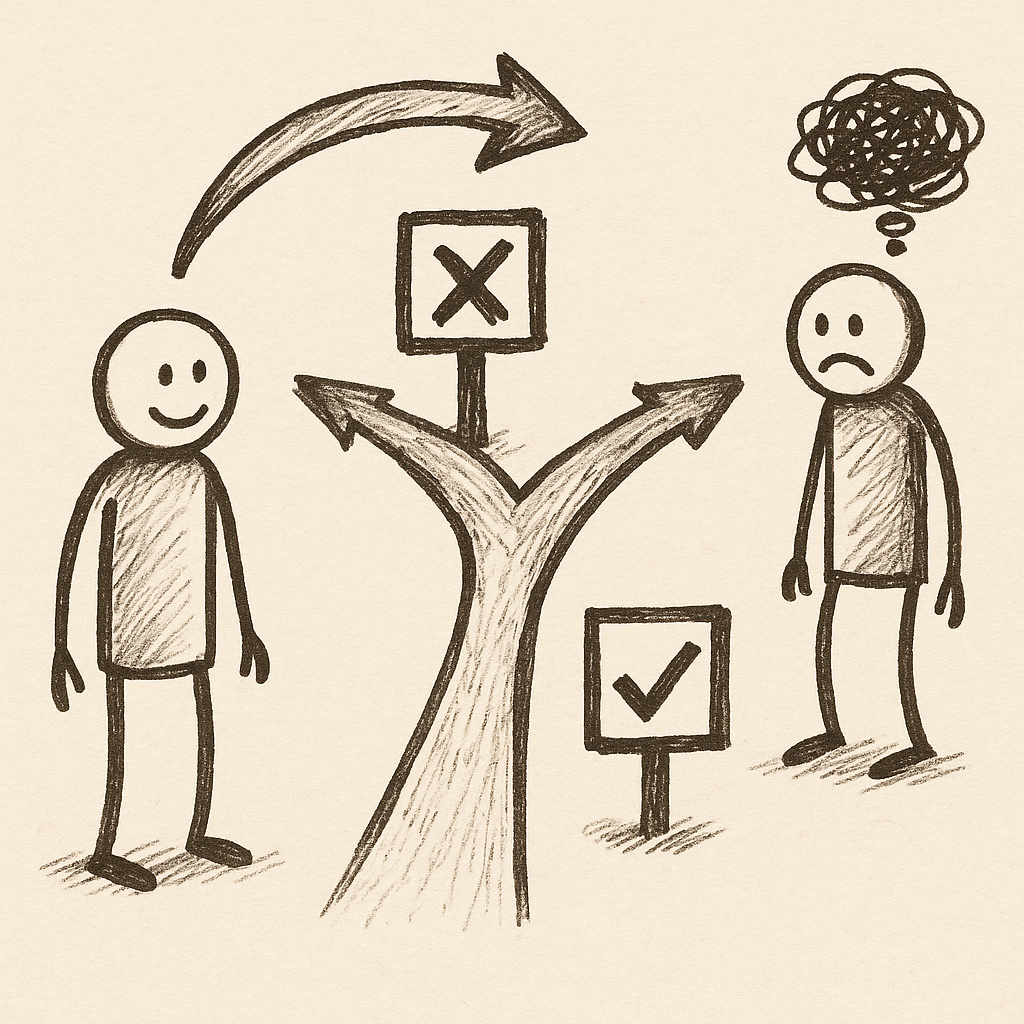
Most product managers chase success by asking, “How do we make this win?” But legendary thinkers like Charlie Munger advocate a different lens—inversion.
Instead of solving for success, solve for failure. Ask:
“How could this launch flop?”
“What will cause users to bounce?”
“What could make this AI model dangerous or misused?”
By focusing on what not to do, you often expose blind spots faster than chasing shiny wins. It’s a humility-first mental model—accept that you’re fallible, and work backwards from failure to design for resilience.
“All I want to know is where I'm going to die, so I'll never go there.” — Charlie Munger
Why it matters in product:
Usability: Users may not tell you what’s broken, but inversion helps you preempt it.
Retention: You don't just build delightful features; you avoid frustrating ones.
GTM: Instead of assuming customers will come, ask why they might ignore or reject you.
Launching our own payment gateway
During my time at Groww, we launched our own payment gateway specifically designed for financial institutions, featuring third-party validation and other specialised capabilities. Before launch, we conducted a detailed pre-mortem that identified potential issues to watch for. This proactive approach allowed us to fix problems in advance and establish a monitoring system for tracking systemic issues during the initial rollout. As a result, we entered production with confidence and successfully managed a large volume of transactions from day one.
Inversion in Practice
Here’s how to apply inversion as a PM:
In Product Reviews:
Ask, “What will make this fail in the real world?”
Don't just celebrate happy paths—hunt the edge cases, dark patterns, or friction points.
In AI Decisions:
Ask, “What’s the worst-case misuse of this model?”
Especially with generative AI, you want to preempt hallucinations, bias, and unintended output.
With Stakeholders:
Use inversion to align early:
“Let’s list 5 ways this can fail and design around them.”
For Roadmapping:
Apply a “kill-switch” lens:
“If this feature caused X, would we pull it from prod?”
On Yourself:
Ask, “What habits could make me an ineffective PM?”
Avoid hero syndrome, over-indexing on shipping over learning, or not listening to users.
The Inversion Checklist
Before launch, run this inverted gut check:
What frustrates our users most in the current flow?
What if no one finds this feature useful—what would they say?
What’s the easiest way for a bad actor to misuse this AI system?
What assumptions, if false, would tank this?
Inversion doesn’t mean being pessimistic. It means being product-realistic. Great PMs don’t just chase wins—they design failure out of the system.